
Sewage Treatment
In the wastewater treatment industry, magnetic levitation (maglev) blowers represent a revolutionary alternative to traditional Roots and multi-stage centrifugal blowers.
Their core advantage lies in the application of magnetic bearing technology combined with a high-speed permanent magnet synchronous motor, achieving complete impeller levitation and contactless rotation.
This fundamental technological leap grants maglev blowers unmatched overall performance in wastewater treatment applications.
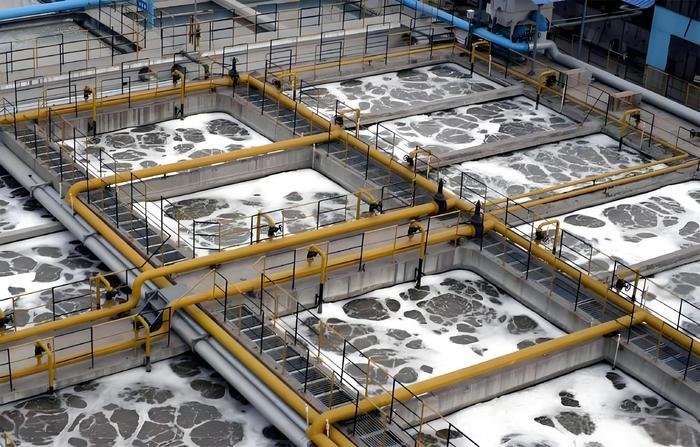
1. Exceptional Energy Efficiency — Dramatically Reducing Power Consumption
This is the most compelling advantage of maglev blowers.
No Mechanical Friction Losses:
Conventional blowers experience substantial friction losses in gearboxes, bearings, and other mechanical components.
Maglev blowers, by contrast, use fully levitated rotors that rotate without contact or lubrication, thereby eliminating friction and maximizing the conversion of electrical energy into kinetic airflow.High-Efficiency Impeller and Motor:
A high-performance centrifugal impeller is directly driven by a high-speed permanent magnet synchronous motor (PMSM), delivering outstanding efficiency and stability.Smart Frequency Control to Prevent Energy Waste:
The built-in high-speed frequency converter allows infinitely variable speed control from 30% to 100%, adjusting airflow precisely according to the real-time dissolved oxygen (DO) demand in the biological treatment tank.
This enables on-demand aeration and eliminates the inefficiency of oversized, constant-speed systems.Performance Data:
In real-world operation, maglev blowers typically achieve 25%–50% energy savings compared to Roots blowers.
For medium-sized wastewater treatment plants, electricity costs can represent 60%–70% of total operating expenses, with aeration systems accounting for the largest share (50%–70%).
Consequently, the investment in maglev blowers generally achieves payback within 1–3 years.
2. Minimal Maintenance and Low Lifecycle Cost
No Gearbox, No Lubricant:
Eliminates oil replacement, labor costs, and the risk of oil leakage or environmental contamination.No Mechanical Bearings:
With no wear-prone parts such as bearings or bushings, routine replacement is unnecessary, greatly reducing maintenance costs and spare part usage.Long Service Life:
Key components are engineered for longevity, dramatically lowering the Life Cycle Cost (LCC).
Routine maintenance is limited mainly to air filter replacement — reducing service requirements by over 95%.
3. Low Noise and Vibration — Enhanced Working Environment
Contact-Free Operation:
With no physical contact between rotating parts, mechanical impact and vibration are virtually eliminated, and noise originates primarily from the airflow itself.Measured Performance:
Operating noise is typically kept below 80 dB (measured 1 meter from the unit), while Roots blowers often exceed 100 dB and require soundproofing enclosures.
This quiet operation significantly improves the workplace environment, meeting both environmental and occupational safety standards.
4. Clean, Oil-Free Air Supply
The entire system operates without lubricating oil, ensuring 100% oil-free air output.
Protecting Microbial Populations:
Prevents the inhibitory and toxic effects of oil vapors on beneficial microorganisms in biological treatment systems, improving treatment efficiency and process stability.Protecting Membrane Systems:
In MBR (Membrane Bioreactor) processes, oil-free air prevents membrane clogging, extends cleaning intervals, and prolongs membrane lifespan.
5. Intelligent Control and High Integration
Built-In Smart Control System:
Equipped with advanced PLCs or dedicated controllers offering one-touch start/stop, automatic frequency regulation, self-diagnosis, and remote monitoring.Seamless Integration with Smart Water Management Systems:
Easily integrates into plant-wide control platforms for precise, closed-loop aeration control.
It can link with online DO sensors for fully automated operation, forming a core component of modern “Smart Water Plants.”Real-Time Data Monitoring:
Operators can remotely monitor parameters such as air pressure, flow rate, speed, current, and temperature to ensure optimal system performance.
6. Easy Installation and Compact Design
Modular Construction:
High system integration allows for plug-and-play installation, requiring only inlet, outlet, and power connections.
This reduces installation time and complexity.Compact Footprint:
Compared with the traditional combination of “blower + gearbox + silencer + cooling system,” maglev blowers occupy significantly less space, simplifying plant layout and saving valuable floor area.
Comparison Summary
With its revolutionary technology, the maglev blower delivers a comprehensive upgrade to the wastewater treatment industry —
energy savings, reduced consumption, lower noise, maintenance-free operation, and intelligent control.
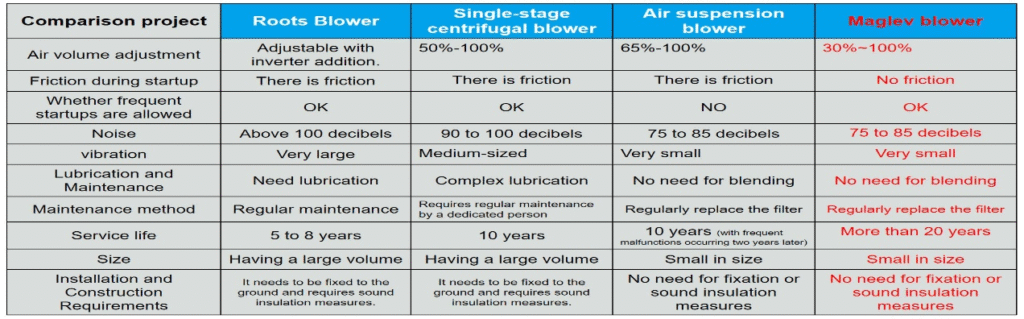
Although its initial purchase cost is higher than conventional equipment, its substantial energy savings and near-zero maintenance make the total lifecycle cost (LCC) far more competitive.
It is not only an ideal solution for enterprises pursuing carbon reduction and sustainable development, but also the optimal choice for utilities advancing toward refined and intelligent plant management.
Maglev blowers have become the preferred technology for both new and retrofit aeration systems in wastewater treatment facilities worldwide.
Application Case
Jiangxi Wastewater Treatment Plant, China
Treatment Capacity: 8,000 m³/day
Influent COD: 10,000 mg/L → Effluent COD: ≤ 500 mg/L
The plant originally operated four 90 kW, 80 kPa Roots blowers, which consistently failed to meet dissolved oxygen requirements.
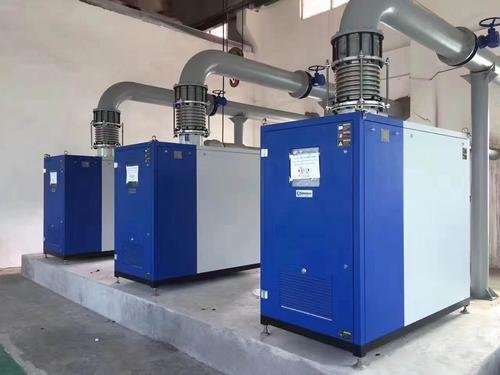
After on-site inspection and analysis, SCO Power engineers proposed an optimized solution — replacing them with three 75 kW, 80 kPa maglev blowers.
This upgrade completely resolved the plant’s DO deficiency problem.
One year later, our engineers revisited the site and received enthusiastic feedback:
the maglev blowers were operating stably, and annual energy savings exceeded the total cost of the upgrade.
We sincerely thank the Jiangxi wastewater treatment team for their trust and partnership with SCO Power.