
Chemical Industry
Air compressors are among the most important and valuable pieces of equipment in the chemical industry, widely used for gas compression and transport across a range of processes.
Typical applications include
Typical applications include:
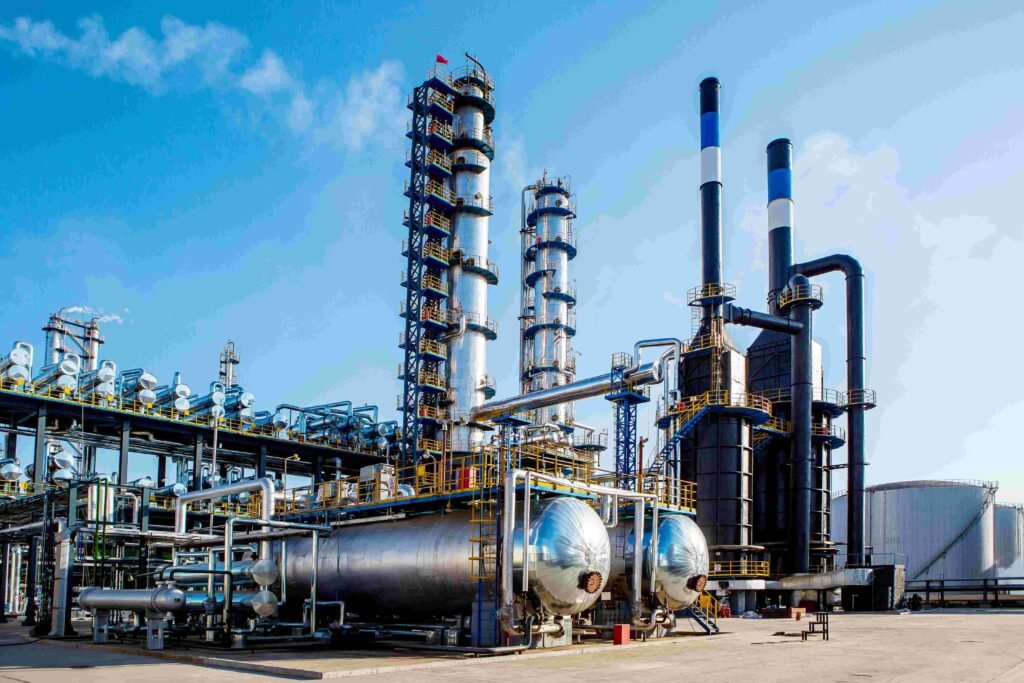
- Process air compression: Supplying compressed air for chemical reactions such as oxidation and fluidized bed processes.
Off-gas recovery and recycling: Recovering and pressurizing off-gases in chlor-alkali and nitric acid production.
Inert gas blanketing: Compressing inert gases such as nitrogen for reactor blanketing and purging.
Cracked gas compression (e.g., ethylene, propylene): In advanced petrochemical plants, magnetic levitation compressors are used to compress high-temperature, high-value process gases, where oil-free operation is essential.
CO₂ compression: Used in urea production and carbon capture and storage (CCUS) systems.
Process ventilation and material handling: Providing pneumatic conveying of powders or granules and ventilation for reactors.
Importance of Oil-Free Operation
In chemical production, process safety and product purity are paramount.
Traditional compressors that use gearboxes and hydrodynamic bearings require large quantities of lubricating oil. If an oil seal fails, lubricant leakage can lead to:
Catalyst poisoning: Expensive catalysts can be deactivated, causing substantial economic losses and production downtime.
Product contamination: In processes producing food-grade CO₂, electronic-grade specialty gases, or high-end polymers, even trace amounts of oil are unacceptable.
Reaction failure: Oil contamination may alter chemical pathways, generate unwanted byproducts, or even trigger safety incidents.
Maglev technology completely isolates the “gas” and “oil” circuits, eliminating the risk of oil contamination and ensuring 100% oil-free compression.
Superior Energy Efficiency
The chemical industry is one of the world’s largest energy consumers, with electricity representing a major portion of operating costs. Maglev compressors significantly reduce energy consumption through three key mechanisms:
Elimination of transmission losses – The direct-drive design removes gearbox losses (typically 2–5%).
Elimination of friction losses – Contactless magnetic bearings remove mechanical friction entirely.
Intelligent speed regulation and on-demand power – The compressor speed automatically adjusts in real time based on process flow and pressure, maintaining operation at the most efficient point.
This avoids energy waste from throttling or overcapacity operation (“a large horse pulling a small cart”).
Total energy savings typically reach 20–35%.


Exceptional Reliability and Minimal Maintenance
Wear-free operation: The core rotating components are completely contactless, eliminating mechanical wear on bearings and gears.
Condition monitoring and predictive maintenance: Magnetic bearings serve as high-precision sensors, continuously monitoring rotor vibration, displacement, temperature, and other parameters.
The system can provide early warnings of potential issues such as blade fouling or rotor imbalance, enabling predictive maintenance and preventing unplanned shutdowns.
In continuous chemical production, unexpected downtime can cause losses far exceeding the value of the equipment itself. Maglev compressors help ensure stable, continuous, and efficient operation—a critical advantage for modern chemical plants.